Showing posts with label MOOCs. Show all posts

Sunday, November 16, 2014

Intellectual Foundations of Modern Liberal Education


 Just visited a 3rd International Conference "Intellectual Foundations of Modern Liberal Education" organized by the Faculty of Liberal Arts and Sciences (Smolny College) of St. Petersburg State University. That institution was founded in 1994 by St. Petersburg State University in close collaboration with Bard College (USA).
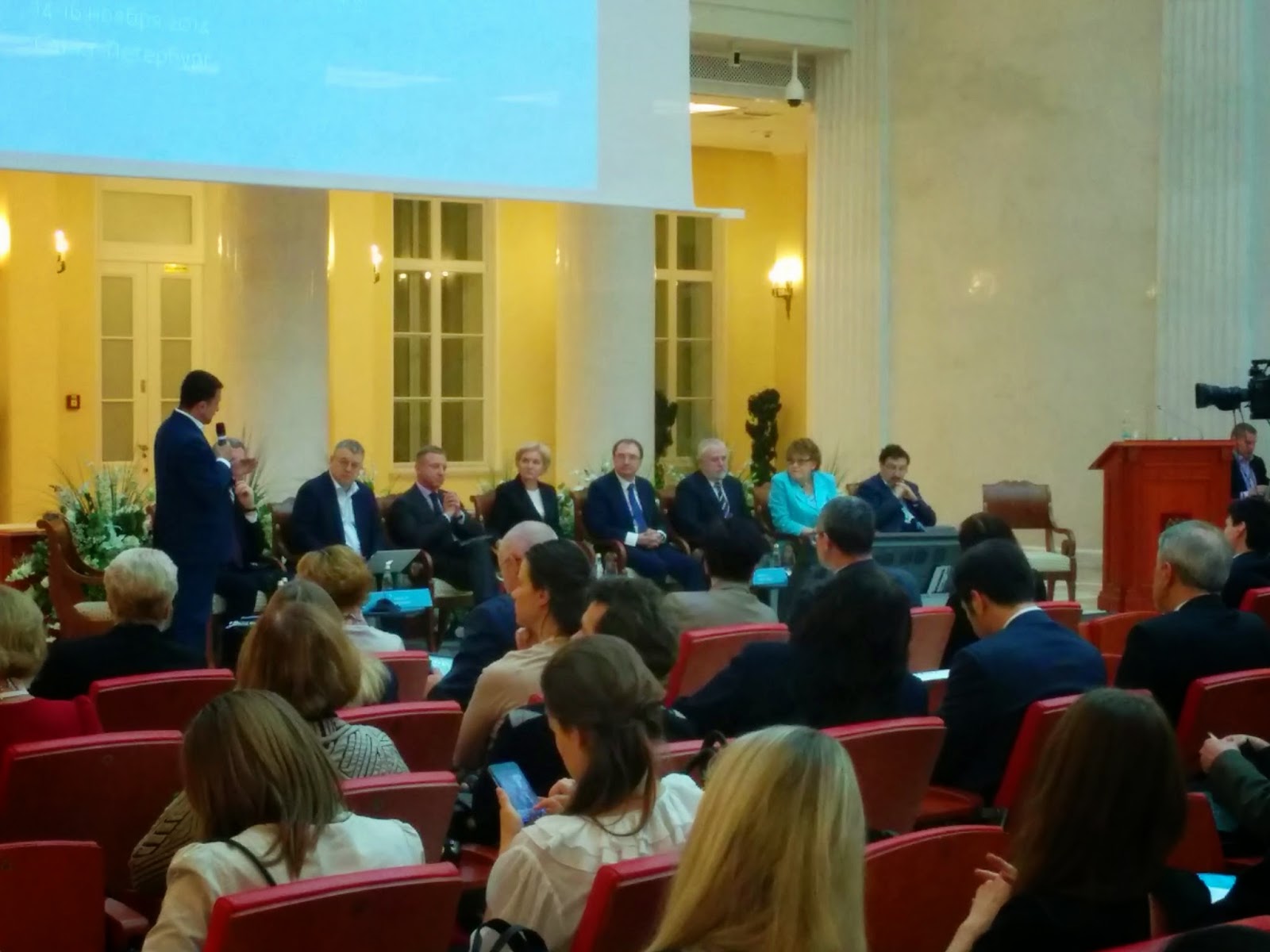
Few notes from the key roundtable "Perspectives of Development of Modern Education in Russia" moderated by Aleksandr Arkhangelskiy with following high-profile participants:

  • Olga Golodets (Deputy Prime Minister of the Russian Federation)
  • Dmitriy Livanov (Minister of Education and Science of the Russian Federation)
  • Nikolay Kropachev (Rector, Saint Petersburg State University)
  • Aleksei Kudrin (Dean, Faculty of Liberal Arts and Sciences, Saint Petersburg State University)
  • Lyudmila Verbitskaya (President, Russian Academy of Education)
  • Yaroslav Kuzminov (Rector, National Research University Higher School of Economics)
  • Vladimir Mau (Rector, Russian Presidential Academy of National Economy and Public Administration)
Introduction of 2-level graduate system (bachelor and master degrees) in Russia was appraised by all the participants. 
Nikolay Kropachev talked about integrated bachelor programs where e.g. biology and chemistry studied as well as computer science. While Olga Golodets mentioned that in the one of the previous experts sessions they concluded that research universities with no medicine faculty/school have no future and in turn there's no future for medicine universities without strong engineering/computer science departments. 
Yaroslav Kuzminov have noticed that liberal arts and sciences programs becomes more popular as the future itself becomes more uncertain. He added that MOOCs come in the education landscape and allow more free choices for students. Vladimir Mau talked about their experience in running a liberal 'management arts' program where they teach students to feel themselves in someone's others shoes (e.g. with help of applied history course) and practice interdisciplinary course works and projects.
The panelist were questioned by Oleg Kharhordin (Rector of European University in St. Petersburg) whether they remembered that " in its origins the liberal arts (Latin: artes liberales) are those subjects or skills that in classical antiquity were considered essential for a free person (Latin:liberal, "worthy of a free person") to know in order to take an active part in civic life (public debate, defending oneself in court) and be successful in it.

Saturday, October 18, 2014

EdCrunch Moscow

Education Industry in Russia is booming. Universities hire new breed of management and become more agile then ever while new organizations and communities take significant part in the new knowledge ecosystems. Institutions with centuries of history and newcomers both are eager to integrate itselves into global context.


It's reflected by EdCrunch Moscow conference - a first major event in Russia to bring together 600+ educators, entrepreneurs, practitioners and researchers from around the world who are engaged in technological development of schools and universities. Russian government institutions were represented by Ministry of Education and Russian Venture Company.

I've been invited to 'EdCrucnh' by Edutain.me, a team, that observes news and changes in the world education. They are the event's co-organizers.

Here's just few highlights.

Day I
Hosted and co-organized by National University of Science and Technology "MISIS".

Top MOOCs were represented by Coursera's co-founder Daphne Koller and EdX CEO Anant Agarwal.

For Coursera Russia is the 8th largest market with local communities and localization projects. Russian Higher School of Economics is well represented with its courses.

EdEx is still looking for Russian partners and as a non-profit initiative cooperates not only with Universities, corporations such as Google and Microsoft are also significant partners.


The panel on MOOCs gathered top Russian experts and managers including Isak Frumin (HSE) and Igor Agamirzyan (RVC). While 2 of 5 rectors (Moscow) at the panel were women.

Day II
Hosted and co-organized by Digital October.
Digital October, founded 4 years acts as a hub for globally-minded technology entrepreneurship community. It is built around two core themes: new technologies and technology entrepreneurship. Key international professional conferences and presentations of new technology products take place there.

The day started with a keynote by Alexa Joyce, Director of Education Policy, Teaching & Learning at Microsoft. A lot of tools and communities for education including Scratch alike Kodu - a framework for kids to create computer games. 

Google were represented in discussions and a workshop with its Russian branch of Google Educators Groups. Teachers and community builders Boris Yarmakhov and Ljudmilla Rozhdestvenskaja shared their experience on using Google tools in schools.


New Professions Lab initiated a panel discussion with the corresponding topic. In November they'll start 'On-line Course Producer' course with Coursera and local experts (including Lektorium.tv).


As future professions were viewed as meta-competences, the role of Universities was agreed as:
While tutors and institutions like tutority were agreed as one of the most needed in the nearest future.

Big data analytics in education were represented in person by Knewton's Charlie Harrington.
Small talks
Both venues were great for coffe-break talks. I had chats with Natalia Tikhomirova, Rector of Moscow Universityof Economics, Statistics and Informatics (MESI), Tanya Stanko - Vice-Provost at Kazan Innopolis Univeristy, Andrey Ivanov vice-chair of the Software Engineering faculty at AU RAS and COO at JetBrains, Grigory Kondakov (Moscow Institute of Physics and Technology and Yandex-CERN collaboration) and Alexey Kotenev (Center for E-Learning at Moscow State University).

Other topics covered
  • Digital pedagogy: mixed educational models, mobile learning, transitioning to 1:1;
  • Learning environments: online educational environments, collaborative learning;

Expo
Both days were satellited with EduTech start-ups (e.g. Stepic) and initiatives (e.g. Globallab.org) expo.


On-line
Almost all the sections of the conference are available on-line (both in Russian and English).

Related events
Just a year before in Helsinki Game|Changers did somewhat smaller about only new breed of educational programs (HyperIsland, Strelka, KaosPilots, The Green Program, ...) - Education Engineering Days. For the next year it looks promising to co-locate EE Days as a part of EdCrunch.