Showing posts with label EN. Show all posts

Friday, November 22, 2024

Game|Changers — Gardening Learning Ecosystems in Between Steady University and Industry Structures

This is a backup of this LinkedIn post.

Finally, the story of ad-hoc education and research program GameChangers Russia is published as a scientific article: ‘Ad-Hoc Education&Research Approach for ‘Gardening’ Learning Ecosystems’ in Subaltern Knowledge in Cultural Practices: Fostering Fairness, Cooperation and Care. Ed. by Milena Dragicevic Sesic, Sarah Cordonnier. University of Arts in Belgrade 2024 (p. 265-286).

Here I explain how the approach was applied for ‘An introduction to the IT Industry’ course which further became a sort of fractal structure with a core team and alumni starting their courses: from biotech, fablabs, and big data to design, future of education, social entrepreneurship, and enterprise architecture.

 Further, I consider how this experience could be applied to deal with multicrisis creating long-term cooperation between universities, ecovillages and other grass-roots ecological and regenerative initiatives, nature reserves, and indigenous people groups.

The publication became possible thanks to “Sharing subaltern knowledge through international cultural collaborations” (SHAKIN’) project that is a European collaboration supported by the EU’s Erasmus+ program: Strategic Higher Education Partnerships for Innovation. See my note about this project.

Here I wanna mention Visnja Kisic and Goran Tomka (Forest University) who supported me on all the stages of participation in SHAKIN and Dima Orlov who supported my stay at the Forest University Residency. Special thanks to Pavel Luksha for advocating for the Learning Ecosystem vision.


Then the gratitude list goes on with those who’ve been involved within the Game|Changers’‘Ecosystem’.

Cofounders Nikolay Vyahhi and Vladimir Aluferov. The core initial team: Anna Chernysh, Aleksandra Kurysheva, Ekaterina Vyahhi, Anna Shikhanova, Maria Yavorkskaya.

Ivan But, Alyona Markovich, Lena Yarmanova, Mikhail Vink, Pavel Votchitsev as the continuators of the framework. 

Academia supporters: Marina Sukhorukova, Tatiana Gavrilova, Andrey Terekhov, Boris Novikov ... 

Industry: Kirill Petrov, Vasily Markov, Veronika Vetrova, Inga Petryaevskaya, Slava Nesterov, Marina Varzar, Andrey Breslav, Oleg Byakhov, 

Development and Higher education institutions: Igor Agamirzian, Eugeny Kuznetsov, Isak Frumin, Alexey Novoseltsev, Igor Egorov, 

GameChangers tracks Roman Musatkin, Kseniia Petrova and Aleksei Pogibelev, Igor Asonov, Julia Karashevich, Maksim Arzumanyan. 

Andrew Paterson for hosting Education Engineering Days in Helsinki 

NёrdCamp key organizers Anastasia Tsvetkova, Katia Lebedeva, and Yegor Naumov. IT Table Tennis Cup - Alexandra Vachnadze.

Design Sergey Karashevich, Grading System Olga Ianiuk.

And all the numerous experts like Vladimir Gorovoy, Anna Degteva, Andrei Afanasiev, Yury Lifshits, Tatiana Lando, Phillip Delgyado, Dmitry Kachmar, Alexey Nikolaev, Ilya Antipov, Denis Stark, Oleg Stepanov, Andrey Breslav, Alexander Shtuchkin, Vitaly Vlasov, Vitaliy Yanko, Alexander Klechikov, Dmitry Pavlov, Elnara Petrova, and many more…!

and all the alumni including Alexandr Kim, who was a master of our cosy atmosphere. Currently, he has been in pretrial detention for over a year in Russia, without any progress in the case of the liability of platforms such as booking with his platform for excursions Sputnik8.com.


Saturday, December 23, 2023

From Parks to Open-Source Food Forests

For the last 1.5+ years I have lived in the Balkans I have felt local landscapes' influence on me. As I wrote here I came up with a regenerative format of 'Open-Source Food Forests'. I've asked Google's Bard to rewrite my notes about it in two ways: as a better native-speaker story and as a technical white paper. Here I put both results -- for keeping history and as searchable texts.


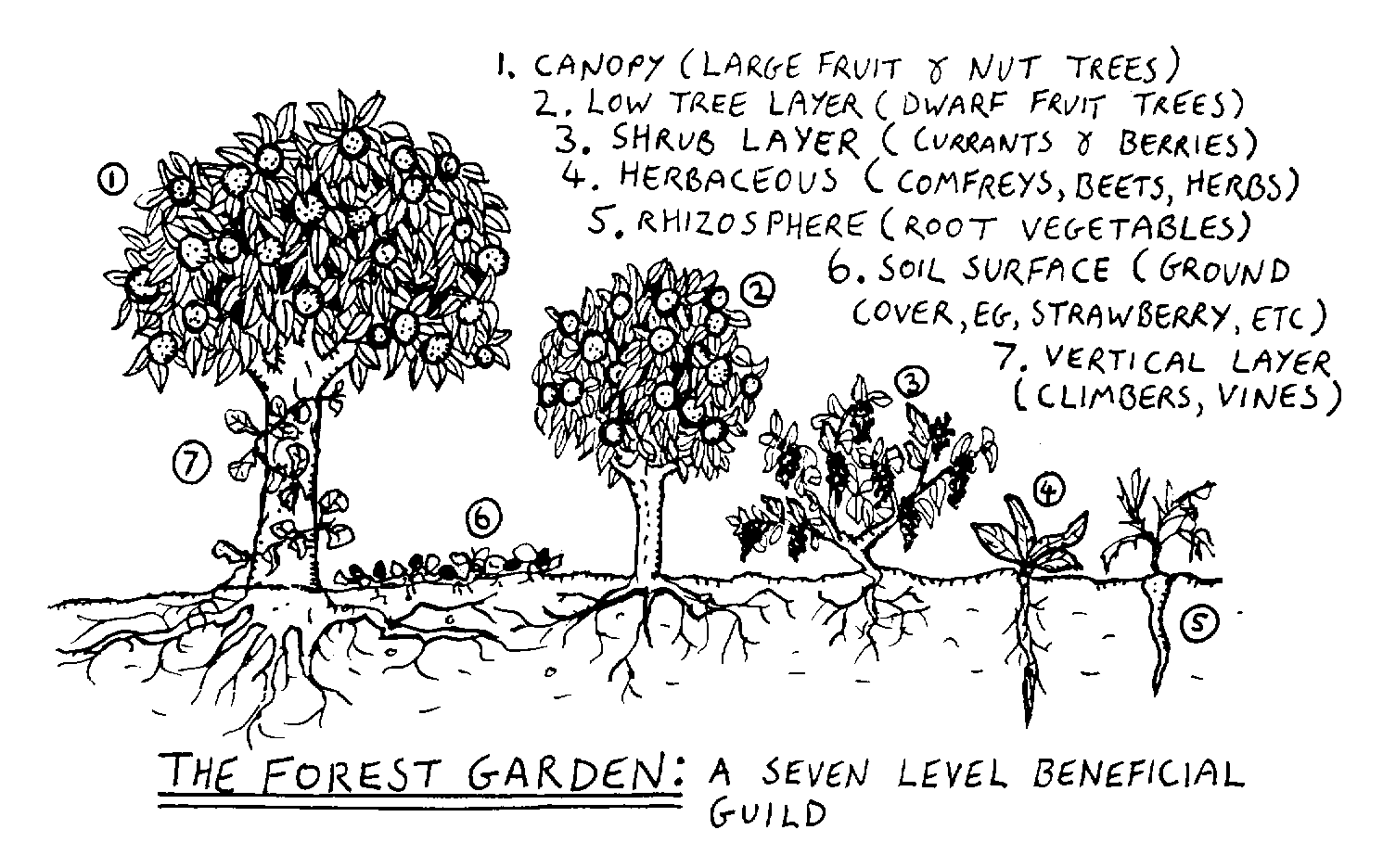
Image from Wikipedia's article on Forest Gardens.

Edition with descriptive language and metaphors to evoke a sense of place and connection to nature.

Wind whipping through my hair, I find myself back in Fruska Gora, not nestled by the Forest University this time, but further east, in the sprawling village of Beocin. Meadows and fields unfurl before me, punctuated by neat rows of apple, plum, and cherry trees in middle-aged gardens. Unlike their wilder cousins in the forest, these trees stand like soldiers, pruned into uniform obedience, a testament to "agricultural routines." But is it beauty, or a plantation? Orderly, efficient, maybe even picturesque, opinions would surely vary. 

Yet, in the wake of wilder, less-tampered landscapes, these orchards spark deeper questions. Yes, those apples feed mouths, but do they truly hold the symphony of nutrients, the full-bodied flavor, the vital spark the researchers claim? Or are they echoes, pale shadows of what nature intended? 

Here's my wild thought: what if a fruit's beauty, the vibrancy of its surroundings, whispers tales of its internal richness, its perfect balance of vitamins, minerals, and that elusive "energy" we can almost taste? Perhaps, beauty is but a mirror reflecting health. 

And so, the stark contrast between manicured parks and untamed forests ignites a vision: Public and private Open-Source Food Forests. Imagine these vibrant oases, a few hectares of regenerative magic woven into the landscape. Places that hum with life, self-sustaining except for gentle tending during harvest. These wouldn't be mere gardens; they'd be living laboratories, breathing testaments to climate resilience. Designed with an eye for the soul, echoing the calming patterns of nature's most serene sanctuaries. 

Schools and universities would flock to these open-air classrooms, to engage in citizen science with open arms. Documentation, research, discoveries - all laid bare on the altar of public knowledge, inviting study, discussion, and action. These wouldn't be just food forests; they'd be vibrant ecosystems of knowledge, growing alongside the fruits and vegetables, nourishing minds as much as bodies. 

So, let's step away from the monoculture rows and venture into the dappled sunlight of Open-Source Food Forests. Let's cultivate not just food, but knowledge, beauty, and connection. Beocin, with its whispering orchards, might just be the perfect starting point.

From Monoculture to Symphony: A Vision for Open-Source Food Forests (a white paper edition)

Abstract: Traditional, intensive agricultural practices often prioritize yield over ecological and human health. This white paper proposes a paradigm shift toward Open-Source Food Forests (OSFFs) - regenerative, self-sustaining ecosystems designed to foster food security, biodiversity, and community engagement. Inspired by observations of diverse, naturally occurring ecosystems, this paper outlines the potential benefits and key features of OSFFs, offering a roadmap for sustainable food production in the face of climate change and environmental degradation. 

Challenges of Modern Agriculture: Conventional agriculture, characterized by monoculture systems and heavy reliance on synthetic fertilizers and pesticides, has demonstrably led to soil degradation, biodiversity loss, and water pollution. Additionally, concerns linger regarding the nutritional quality of produce grown under such methods. These challenges necessitate innovative solutions that prioritize long-term environmental health alongside food security. 

Vision of Open-Source Food Forests: OSFFs offer a promising alternative. Drawing inspiration from natural ecosystems, these multi-layered, polyculture systems mimic the ecological interactions found in healthy forests. By incorporating diverse edible species, from fruit trees to ground covers, OSFFs foster nutrient cycling, natural pest control, and increased resilience to climate change. Importantly, OSFFs prioritize accessibility and transparency through an "open-source" approach. Documentation, research results, and best practices are freely available, encouraging community participation and knowledge sharing. 

Key Features of OSFFs

  • Self-sustainability: Designed to minimize human intervention while maximizing long-term productivity through natural ecological processes. 
  • Regenerative practices: Focus on enriching soil health, enhancing biodiversity, and building climate resilience. 
  • Landscape aesthetics: Intentionally designed to integrate with existing landscapes, promoting beauty and community well-being. 
  • Educational and research hubs: Serve as living laboratories for schools, universities, and citizen scientists, fostering collaborative research and knowledge dissemination. 

Impact and Potential: OSFFs offer a multitude of benefits. They contribute to: 

  • Increased food security: Diversifying food sources and boosting local production, particularly in vulnerable communities. 
  • Enhanced environmental health: Promoting soil health, water conservation, and biodiversity restoration.
  • Community engagement: Fostering social connectedness through shared learning and collaborative food production. 
  • Scientific advancement: Creating open platforms for research and innovation in sustainable food systems. 

Conclusion: Open-Source Food Forests present a promising path towards a more sustainable and equitable future. By transitioning from industrial monocultures to diverse, regenerative ecosystems, we can nourish not only our bodies but also our communities and the planet. This white paper calls for further research, pilot projects, and collaborative efforts to unlock the full potential of OSFFs and redefine the future of food production.


Thursday, February 16, 2023

SCHOOL, HOME SCHOOL, UNSCHOOL, THE LAST SCHOOL

SCHOOL, HOME SCHOOL, UNSCHOOL, THE LAST SCHOOL 

Trebinje, Bosnia and Herzegovina

The Culture of Sharing Knowledge and Skills

  • An average school is to transfer knowledge. A national school system is to form a national state citizen. A private school is about selling a story which parents want to buy.
  • Homeschooling is to follow the national and/or alternative school curriculum where families and friends cooperate to help kids satisfy given/chosen standards.
  • Unschooling - if it's done in a smart way is actually about an individual learning path where a lot of things depend on an exact context.
The shared 'advanced' value of all these options is to gain the skill of (self/group) learning. It's about teaching kids how to learn, even better - to create an environment where they learn it in practice.

But I believe, it's not enough.
I see undervalued two other attitudes and corresponding skills
 - curiosity to create/synthesize new knowledge and practices/abilities;
 - love to share acquired knowledge/skills with others and the art of doing it in the most convenient way.
  
And it's not only just out of the agenda. It's kind of forbidden for everyone. Because the mainstream message is that:
 - to help others get new knowledge - you have to have a degree in pedagogy
 - to create new knowledge you have to be a scientist and belong to various academic institutions.

The Last School

So my point is that schools as institutions are TEMPORARY vehicles of civilization, and if even to start a new school or update an existing one is to co-create an environment where kids and adults preserve an evolutionary natural ability and joy of sharing knowledge and skills, so after their experience in this LAST school they won't need to send their own kids to any other schools or go for another time and cost ineffective formal higher education because they are able to organize processes of self-learning and transferring their knowledge and skills to others.   

Inability to Share Knowledge as the Cause of Social Inequality and Separation/Atomization 

These borders, this division of professionalized education and new knowledge creation, I suggest, is one of the intrinsic causes of inequality that we have in the present society. Our positions there still highly depend on what education we have. Our abilities for critical thinking and to see things as they are, to resist or believe in the propaganda and to follow simple answers are still too often based on having a privileged status. It's really hard to communicate your knowledge and vision to people who are not in your cultural and professional background/bubble because you lack this practice of giving your knowledge and vision in simple and clear ways.

Professionalized, formalized, and framed in time and institutions education ends us in the situation when it is a default (even amongst well-educated folks) to spend time together by boardgames, going out, and discussing Netflix, but not learn new things from each other or create new and common understandings of unclear things.

Learning Ecosystems are Possible

A decade ago, in St. Peterburg, Russia I co-founded an independent ad-hoc education and research program Game|Changers -- a learning ecosystem where its participants learned to create their own learning ecosystems. It was up and running for four years, while some events and formats inspired by it still work nowadays. Most of the related media highlights and publications were in Russian, but here is one we translated -- Tutors and Colliders: New Ontology for Education.

Wednesday, August 12, 2020

Simple Living Studies. 2015-2020

 For the last five years, I've dropped out of mainstream thinking and values and corresponding mode of operation (or at least I see it like this). Each year I wrote reporting notes (in Russian) with things done, people and places discovered, knowledge/skills acquired and directions and ideas for the next season. 

Reports


1. 2015/2016 Yaroslavl region - one of Russia's State's cradles. Grand-grand parents' lands and contemporary Orthodox communities there. Reconnection with Russian history in the context of local  real stories and my kin's history - behind the official plot that we were taught in school and other state-guided narratives. Orthodox's miracles and XIX century's peasant studies. 


The adventure supported by newly acquired hitchhiking skills and my tutoring abilities to help local children with their studies (Math&English). My professional shift (upshift) from working with university students to school age kids was stimulated by Vladimir Martyshin. Vladimir and his family are the first generation of the post-soviet back-to-the-landers. He started as a farmer, but has become a village's school head soon. Vladimir's kindness and humaneness are things that I remember as guiding principle to live and to create. Here is just published video about his views and the school he nurtured.


One another insight is that adopted kids is a really normal practice. It's not easy, but part of today's culture. Thanks to Dmitry Morozov, Maria and Anton Kuzmins and their colleagues/neighbours in the orphan village 'Orion' (video by BBC and my report). 


A one-year trip that resonates in me with Boris Grebenshchikov's 'Russian Album' (Russkiy al'bom). 

The season's report is here.


2. 2016/2017 Pskov region, Belorussia, Latvia. Ecovillages and Kin's domains. It has opened Russian history in the neighboring countries' context. Physical and mental resurrection in 'Chistoe Nebo' ecovillage. Ecovillages and kin's domains the way to live. Gardening, building, and wild nature being experiences. Living among the forests on the countries' border and between National reserves in really rural homesteads (you have to walk a lot to your closest neighbors) is even better than in the 'just countryside'. 

The season's report.


3. 2017/2018 Soviet Union's South: Crimea, Kaukasus. Mountains, the sea, and the subtropics. Domesticated animals and less domesticated people. Ecovillages, new farmers, and kin's domains. Eating persimmons and pecans right from the trees. Other climate and other cultures. 


While gardening and making friends there, I've got the internal feeling that the planet Earth is a one being and there's no my land and soil and someone's other land and soil. Putting seeds in one place, harvesting in the other - it's part of the nature cycle. And that the friends are everywhere - it's just about to be open and to notice them. 


The Rainbow gathering (Russian edition) made me start to think (but not to feel yet) that there's even no border between lands, there's no border (or 'No Boundary' thanks to K. Wilber) between people and even between everything.

Here are the season's report and a request for body-mind contact


                                                     * * *


Observations through these 3 years made me interested in the real situation with the ecological state of the world. So the next two seasons I've invested to understand what's going on with the Anthropocene's effect on the biosphere.  


4. 2018/2019 Russian North-West

The summer was about the first experience with 'fire-free' and 'people-free' days being in the forest on the Ladoga's lakeshore. It's just a comfortable and healing 'single camping' (not extreme experiments).


The Autumn is in Arkhangelsk region. Been sleeping in October in a hayloft just above goats (I milked them every day) and a horse. The whole winter in Karelia in Kostamuksha Natural Reserve (Russian North-West just on the border with Finland). Nature protection institutions and climate science. Finno-Ugric languages' sounds and rhythms (now I understand why J. R. R. Tolkien was so involved with it). 


I've 'met' a 'colleague of mine' - Elias Lönnrot. A Finnish physician and philologist, he collected and published the epos of past times ('Kalevala') while my field trips bring me the sprouts of possible biocentric future epos and the corresponding values' space. Exact places' reports and analytical notes are published as separate blog posts, two overview articles are part of GEN Russia Annual Newsletters (2019 and 2020). The first one I've translated to English:  Ecovillages, Kin’s Domains, and New Farmers: 25 Years of the Modern ‘Back to the Land’ Movement in Russia/CIS.


As the global and Russian situation with people (including myself) unconsciously using nature and too young nature/organic centric agriculture (permaculture) in Russia I shifted my re-search focus on Scandinavia.


Here is the season's report.


5. 2019/2020 Finland, Sweden, and back to Karelia. Organic and biodynamic farms and Folk Schools. European Ecovillage Network and European Rainbow Gathering (these communities have intersections). Boreal biomes and landscapes. Reindeers and Saami culture. 


I've met new farmers and even new peasants (and worked a little close by) who are vegetarians in such a north climate where agriculture (especially vegetables, fruits, and crops) is considered (in Russia) as of 'high-risk enterprise'. They are self-sufficient, healthy, and thoughtful. Their kids and grandkids are healthy and smart. One of these new peasants - Lasse Nordlund, a half-German/half-Finnish/Swedish former Software Engineer wrote a 'Foundations of Our Lives' book on his personal experience (the book's Finnish version is extended with chapters written by Maria Dorf, Lasse's wife).


But as even peasant lifestyle is somewhat based on significantly advanced technologies my interest grows to indigenous people and their world view and hunting-gathering practices.  


Just before COVID 'self-isolation' had been announced in Russia I came to a Ladoga lake's north shore village (population - 1800) where I've bought an apartment in a duplex (semi-detached house) or 'paritalo' in Finnish with a piece of land for gardening, sauna and summer kitchen (4 chimneys in total). I see this place and space as a living lab for 'back to the land' experiments and to host friends and guests while continuing field trips into the wilder nature and less populated landscapes with original forests.   


No report for this season yet.


Present


After these experiences I find myself on the three planes or coordinate systems:


a. Current social context and 'business almost as usual'.


b. Humans' biosphere fast degradation. Forest clear-cuts, biodiversity loss, drinkable water shortage, weather changes (not just warming). No hope and: 

  • Titanic's (ecological crisis) and
  • Babel Tower (technology risks as civilizational ego and fears grow) 

as metaphors that correspond to my view on what's going on. In Russia, this agenda is so marginalized as the key proponent is a 'new peasant' German Sterligov whose radical views and actions disturb the 'contemporary tolerance level'. In ecovillages and academic society's 'layers', I've met only a tiny group of people - 'On the edge' community and Regional Network for Sustainable Rural Development with the 'Climat, Education and Youth' project. In Europe and Scandinavia, I see more awareness and actions (e.g. Deep Adaptation forumGEN Europe and ECOLISE activities, and University-based events).   

In Russian there is an interview with Alexander Karpov on what are the reasons of the crisis's denial and a vision of possible future for us and next generations (IMHO, it's the most optimistic scenario). I had luck learning from him some of my moderator's skills


c. Search for internal wholeness and 'reach simplicity'. Deeper contact with my own body and the 'inner cosmos', finding 'qi' or 'prana' or whatever word it means. As now I'm sure that 'qi' skills are not only about self-healing. Even gardening requires it. Feeling 'own' qi allows interaction with other 'qi' streams in organisms and landscapes ('external cosmos'). This mastership allows the next level in reducing personal consumption impact on nature and dependence on big social institutions (e.g. healthcare, schools, money) and everyday things (simpler cloth and tools). While having a more intact connection with wild nature - wolves and dolphins, trees and birds, tomatoes and bees, waters, and stones.


'B' and 'C' planes look like two projections of the same process. Advances in 'C' provide more sustainability and survivability for situations in 'B'. While forgetting 'A' (or just trying to escape it) - is to bury a head in the sand.


So, what's next?


I. Europe's South-East (small countries and nature diversity) as some of the countries are Slavic language group - it's also a linguistic and anthropology research for Slavic roots and sub-collective unconsciousness. And what it is to be (in) a small country? I've looked at this region for the last 4 years - now there are exact people and places to come and ideas to verify. 

  • Nara Petrovich (simple living) and Marko Pogačnik (understanding earth live) in Slovenia; 
  • organizations that are not only about ecology but with wider scopes: GAIA Kosovo in Kosovo and Impact Hub in Romania. 
  • Ecovillage Zaježka in Slovakia. 
  • Serbia, Croatia, Albania - still unclear. Georgia and Armenia - maybe. 
II. Indigenous and/or rural (SaamiDungan, ...) people and old believers. The 'World in faces' project by Alexander Khimushin provides some directions for the search. Shifting perspective views to cosmological perspectivism (a concept coined by the Brazilian anthropologist Eduardo Viveiros de Castro to encapsulate indigenous conceptions, he is know for his book 'Cannibal Metaphysics'). And deeper to Nature, somewhat one of the largest Russia's natural reserve - Pechoro-Ilych Nature Reserve in Komi Republic. Scandinavia is still an option for such experiences. Longer stays in wild nature (for the set of reasons, e.g. to get effects similar to 'vipassana', insights like Vladimir Serkin's studies in Russian's Far East, ...) 

III. On the 'A' plane, maybe: Deep adaptation labs (an international initiative that includes Universities, ecovillages, nature reserves, ecological communities in cities, ...) and 'qi' research groups.

Saturday, January 31, 2015

Work and Life in Education and Research. 2014 report.

Here's just few key highlight of what I've been busy in 2014.

Work

After stepping out from GameChangers management team I've started to look for less entrepreneureal type of jobs. I've got four roles:

Researcher
January - May. I've studied how companies like Google, Valve and Yandex are organized internally. This project was requested and funded by JetBrains (deliverables were an internal set of reports). Further I've continued the project as seminars about organizational design.


Moderator and story-teller 
July - August. As a guest at Ladoga lake's shore festival named as 'Otkrytie' (in Russian it meams 'discovery' and 'opening') I moderated informal experience sharing on topics related to education and healthcare. My own content I've delivered in form of workshops about future of education, professional orientation and strategic planning in agile organizations (mainly based on OKRs). All this job was done for food and housing and it was probably the best work in 2014.

Writer
August - September. In the summer I thouth what if to write for money? In 2013 I was very delighted to to work with Anton Shirikov as an editor to publish an artcile 'Tutors and Colliders' in Slon.ru (for English edition see Medium's post). So our collaboration continued with this two texts:


Then Anton has quited Slon to join RBC and I gaved up writing. But yep, that was nice experience. I've got positive feedback and > 10 000 views for each article.

Manager (University Relations Specialist)
September - December. After the research my interest in joining Google has grown, while my Googler-friends reffered me to a position in Moscow office (in the Summer there were more then 20 open positions). All the expectations about Google itself were met, while it terms of the position (context, job resposibilites and mode of operation) - we've seen it completely different with my manager. We've stopped to work together after 3 month. My conclusions:
  • it's mandatory to get far more information about the position before accepting the offer 
  • it's complicated for me to work as a manager (especially within very distributed team) 
The key impression: Google really has one of the most strongest corporate culture of our times. It's potential is still in it's beginning.

Education Ecosystem Events to highlight

 
  • Already mentioned 'Opening' Festival
  • yCamp by Andrei Afanasiev and Co (contributed, but didn't attend due to relocation to Moscow)
  • EdCrunch (attended, but I've rejected to contribute due to being busy with Google)

People of 2014

Ekaterina Peskova. Moved from microbiology to study and teach body-mind practices. We've met at Google's corporate yoga classes in Moscow. With her strong background in natural sciences and psychology Ekaterina examines and merges different approaches from East and West. It was most mindful practices I've ever attend before.
Victor Udoewa. Moved form Washigton to London to join Google. We've e-met even before my first day in a company - he wrote so warm welcome email, so I've searched for Victor's profiles in the Internet and have been impressed with his talents and activites. It was a wonder looking at how he conducts wokshops and training for students in Dublin's Google Campus Ambassador Summit.  

What about GameChangers?

I've put my head and hands out of it. These activities were done by alumni:

Personal Experience

Reconnection with parents and digging my roots out. Exploring family trees and stories are also about discovering culture of Christianity in Russia. 

Readings

Travel


What's next?

It's my fifth month in Moscow (I've moved here to join Google) and I don't feel comfortable with idea to come back to St. Petersburg (but other cities and countries). Areas and roles to work in still are to decide: media, research, consulting, healthcare or something completely different, e.g. art or juggling classes for office workrers. I do exercises with balls for about half of the year - it's not about how many balls you can manage it's about how do you fell a single one.

Dream job is about these features:
  • strong teams (or a strong partner for small projects)
  • location in mild climat or any comfortable environment (e.g. Europe/US or less obvious but fresh choices like Lebanon, Armenia, Georgia or Azerbaijan)
  • related to 
    • asking questions
    • organizational design
    • combination of media, education, research, art and business
    • social/technology ecosystems and foresights
    • healthcare and body-mind studies 
    • working with dolphins