For the last 1.5+ years I have lived in the Balkans I have felt local landscapes' influence on me. As I wrote here I came up with a regenerative format of 'Open-Source Food Forests'. I've asked Google's Bard to rewrite my notes about it in two ways: as a better native-speaker story and as a technical white paper. Here I put both results -- for keeping history and as searchable texts.
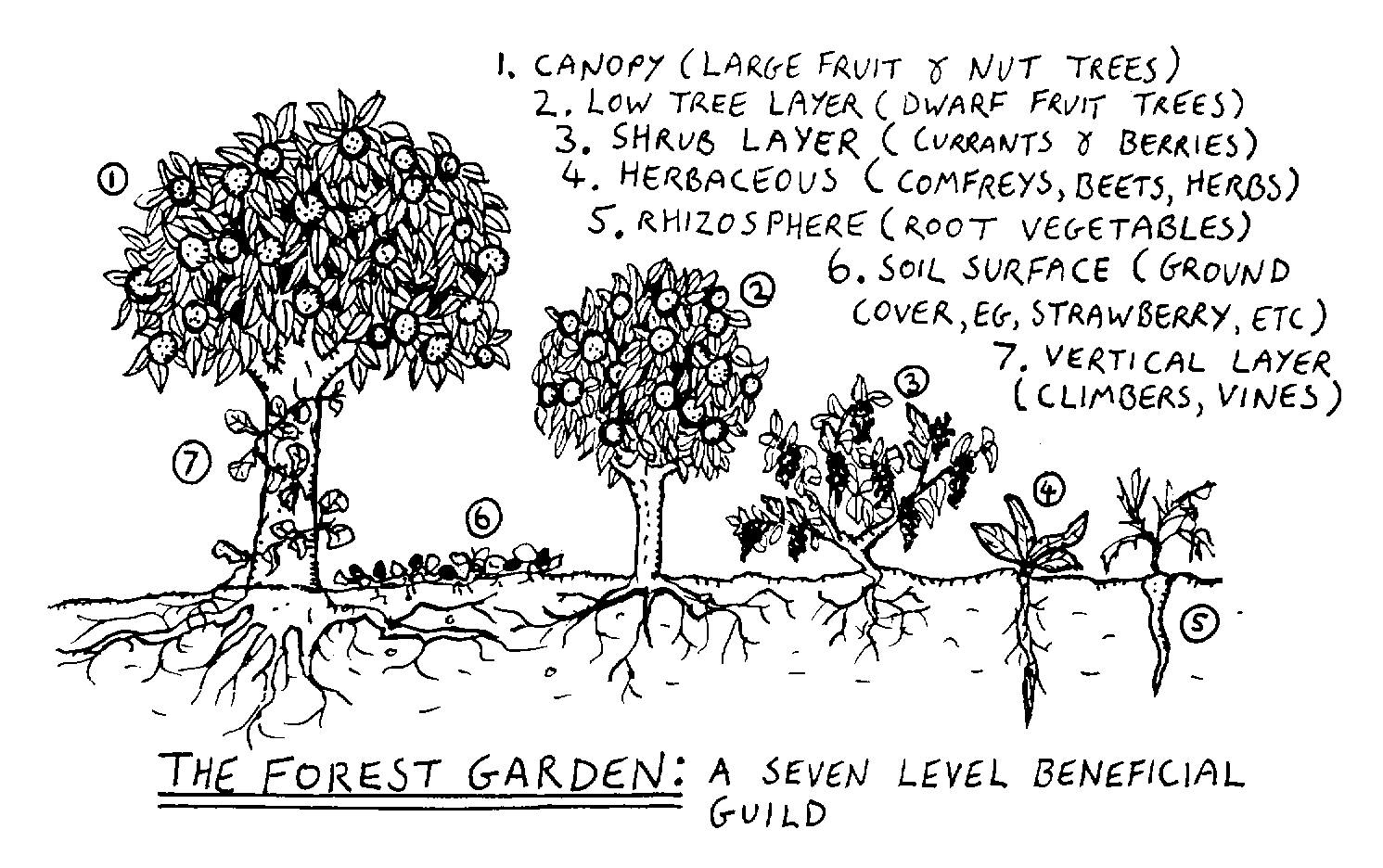
Image from
Wikipedia's article on Forest Gardens.
Edition with descriptive language and metaphors to evoke a sense of place and connection to nature.
Wind whipping through my hair, I find myself back in Fruska Gora, not nestled by the Forest University this time, but further east, in the sprawling village of Beocin. Meadows and fields unfurl before me, punctuated by neat rows of apple, plum, and cherry trees in middle-aged gardens. Unlike their wilder cousins in the forest, these trees stand like soldiers, pruned into uniform obedience, a testament to "agricultural routines." But is it beauty, or a plantation? Orderly, efficient, maybe even picturesque, opinions would surely vary.
Yet, in the wake of wilder, less-tampered landscapes, these orchards spark deeper questions. Yes, those apples feed mouths, but do they truly hold the symphony of nutrients, the full-bodied flavor, the vital spark the researchers claim? Or are they echoes, pale shadows of what nature intended?
Here's my wild thought: what if a fruit's beauty, the vibrancy of its surroundings, whispers tales of its internal richness, its perfect balance of vitamins, minerals, and that elusive "energy" we can almost taste? Perhaps, beauty is but a mirror reflecting health.
And so, the stark contrast between manicured parks and untamed forests ignites a vision: Public and private Open-Source Food Forests. Imagine these vibrant oases, a few hectares of regenerative magic woven into the landscape. Places that hum with life, self-sustaining except for gentle tending during harvest. These wouldn't be mere gardens; they'd be living laboratories, breathing testaments to climate resilience. Designed with an eye for the soul, echoing the calming patterns of nature's most serene sanctuaries.
Schools and universities would flock to these open-air classrooms, to engage in citizen science with open arms. Documentation, research, discoveries - all laid bare on the altar of public knowledge, inviting study, discussion, and action. These wouldn't be just food forests; they'd be vibrant ecosystems of knowledge, growing alongside the fruits and vegetables, nourishing minds as much as bodies.
So, let's step away from the monoculture rows and venture into the dappled sunlight of Open-Source Food Forests. Let's cultivate not just food, but knowledge, beauty, and connection. Beocin, with its whispering orchards, might just be the perfect starting point.
From Monoculture to Symphony: A Vision for Open-Source Food Forests (a white paper edition)
Abstract: Traditional, intensive agricultural practices often prioritize yield over ecological and human health. This white paper proposes a paradigm shift toward Open-Source Food Forests (OSFFs) - regenerative, self-sustaining ecosystems designed to foster food security, biodiversity, and community engagement. Inspired by observations of diverse, naturally occurring ecosystems, this paper outlines the potential benefits and key features of OSFFs, offering a roadmap for sustainable food production in the face of climate change and environmental degradation.
Challenges of Modern Agriculture: Conventional agriculture, characterized by monoculture systems and heavy reliance on synthetic fertilizers and pesticides, has demonstrably led to soil degradation, biodiversity loss, and water pollution. Additionally, concerns linger regarding the nutritional quality of produce grown under such methods. These challenges necessitate innovative solutions that prioritize long-term environmental health alongside food security.
Vision of Open-Source Food Forests: OSFFs offer a promising alternative. Drawing inspiration from natural ecosystems, these multi-layered, polyculture systems mimic the ecological interactions found in healthy forests. By incorporating diverse edible species, from fruit trees to ground covers, OSFFs foster nutrient cycling, natural pest control, and increased resilience to climate change. Importantly, OSFFs prioritize accessibility and transparency through an "open-source" approach. Documentation, research results, and best practices are freely available, encouraging community participation and knowledge sharing.
Key Features of OSFFs:
- Self-sustainability: Designed to minimize human intervention while maximizing long-term productivity through natural ecological processes.
- Regenerative practices: Focus on enriching soil health, enhancing biodiversity, and building climate resilience.
- Landscape aesthetics: Intentionally designed to integrate with existing landscapes, promoting beauty and community well-being.
- Educational and research hubs: Serve as living laboratories for schools, universities, and citizen scientists, fostering collaborative research and knowledge dissemination.
Impact and Potential: OSFFs offer a multitude of benefits. They contribute to:
- Increased food security: Diversifying food sources and boosting local production, particularly in vulnerable communities.
- Enhanced environmental health: Promoting soil health, water conservation, and biodiversity restoration.
- Community engagement: Fostering social connectedness through shared learning and collaborative food production.
- Scientific advancement: Creating open platforms for research and innovation in sustainable food systems.
Conclusion: Open-Source Food Forests present a promising path towards a more sustainable and equitable future. By transitioning from industrial monocultures to diverse, regenerative ecosystems, we can nourish not only our bodies but also our communities and the planet. This white paper calls for further research, pilot projects, and collaborative efforts to unlock the full potential of OSFFs and redefine the future of food production.